
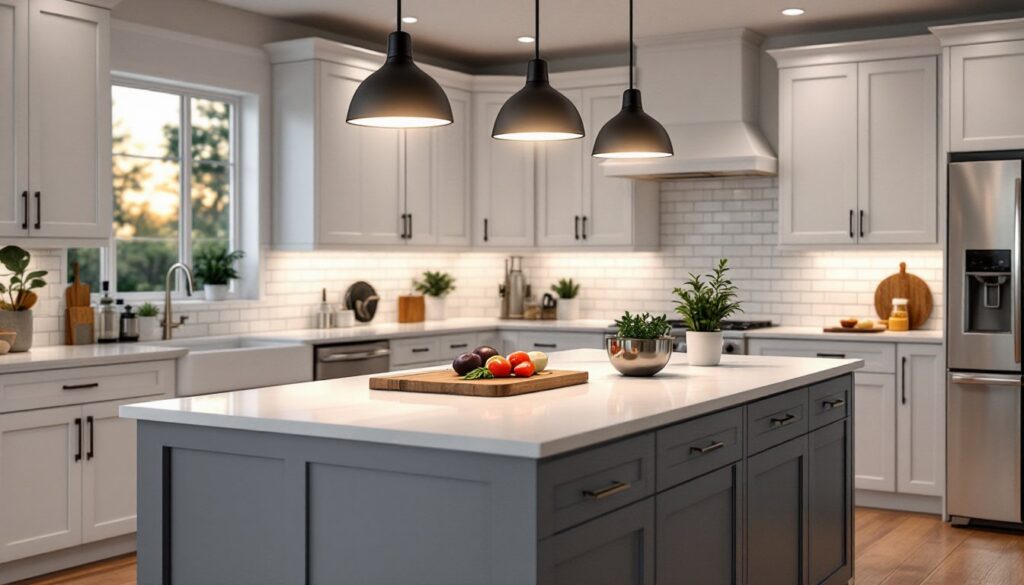
Lighting a kitchen island isn’t just about screwing in a couple of bulbs and calling it done. The island’s where prep work happens, where kids do assignments, where guests hover during parties. It needs task lighting that actually works, ambient light that sets the mood, and fixtures that don’t look like an afterthought. Get the placement wrong and you’re staring at glare on your cutting board. Pick the wrong size and the whole room feels off-balance. But nail it? Your kitchen island becomes the functional and visual anchor of the space.
Table of Contents
ToggleKey Takeaways
- Proper lighting for island kitchen fixtures requires task lighting for food prep, ambient light for mood, and correct placement 30–36 inches above the countertop to avoid glare and obstructions.
- Pendant lights are the ideal choice for islands under 6 feet long, while linear fixtures and chandeliers work best for larger islands and open-concept spaces where they serve as visual anchors.
- Choose lighting fixtures that are one-third the width of your island and use odd numbers (three, five) for balanced spacing across the island’s length to avoid dark gaps.
- Select LED bulbs with 800–1,100 lumens and a color temperature of 3000K–4000K (neutral white) for kitchens to balance task lighting with a warm, inviting feel.
- Proper kitchen island lighting improves safety, enhances the kitchen’s visual hierarchy, and signals design intention to potential buyers, making it a worthwhile investment beyond aesthetics.
Why Kitchen Island Lighting Matters
An island without proper lighting is a dark countertop with wasted potential. The right fixtures provide task lighting for food prep, no more dicing onions in your own shadow, while adding ambient light that fills the room and makes the space feel complete.
Beyond function, island lighting defines the kitchen’s visual hierarchy. It draws the eye to the center of the room, establishes a focal point, and ties together the cabinetry, backsplash, and flooring. Poorly lit islands feel like an afterthought: well-lit ones anchor the design.
There’s also a safety element. Dull lighting leads to knife slips, spills you don’t see, and general hazards when you’re handling hot pans or sharp tools. Proper illumination keeps the workspace safe and efficient, especially if multiple people are cooking at once.
Finally, kitchen island lighting affects resale value. Buyers notice thoughtful lighting choices. It signals that the home was maintained with care and designed with intention. Outdated or mismatched fixtures stick out, and not in a good way.
Types of Lighting Fixtures for Kitchen Islands
Choosing the right fixture type depends on your island’s size, ceiling height, and how much visual weight you want the lighting to carry. Here are the most common options, and when each one makes sense.
Pendant Lights
Pendant lights are the workhorse of island lighting. They hang from the ceiling on a cord, chain, or rod, delivering focused task light exactly where you need it. Because they come in nearly every style, globe, drum, cage, cone, bell, geometric, you can match almost any design aesthetic.
Single pendants work well over compact islands (under 4 feet long). For longer islands, use multiple pendants spaced evenly to avoid dark gaps. Materials range from glass and metal to woven rattan and concrete, so pick something that complements your cabinet hardware and faucet finishes.
One advantage of pendants is adjustability. Many come with adjustable rods or cords, letting you dial in the perfect hanging height. They’re also easier to install than chandeliers if you’re doing the work yourself, most mount to a standard electrical box.
Pendants with exposed bulbs create a modern or industrial vibe, but keep in mind you’ll see the bulb directly. Choose LED filament-style bulbs if you want the Edison look without the wattage and heat. Shaded or diffused pendants soften the light and reduce glare, which is better for task-heavy islands.
Chandeliers and Linear Fixtures
Chandeliers used to be reserved for dining rooms, but modern kitchen designs have welcomed them over islands. A chandelier works best over a large island (6 feet or longer) or in open-concept spaces where the island doubles as a dining or entertaining area. They add drama and a sense of occasion.
Linear fixtures, also called linear chandeliers or suspension lights, are essentially stretched-out pendants. They run parallel to the island’s length, providing even light distribution without needing multiple fixtures. These are popular in contemporary and transitional kitchens.
Linear fixtures typically measure 30 to 50 inches long and suit islands between 5 and 8 feet. They’re ideal if you want a cleaner look with fewer hanging elements. Many styles of lighting lean on linear designs for their sleek, streamlined profile.
If your island has seating, a chandelier or linear fixture creates a defined zone above the seating area, almost like a dining space within the kitchen. Make sure the fixture doesn’t hang so low that it blocks sightlines across the room.
How to Determine the Right Size and Number of Fixtures
Getting the size and count right is part math, part eyeballing. Start with the island’s dimensions.
For pendants: A common guideline is to use fixtures that are one-third the width of the island. For example, if your island is 36 inches wide, aim for pendants around 12 inches in diameter. If the island is 48 inches wide, 16-inch pendants work well.
For length: If the island is 6 feet long, use three pendants spaced roughly 24 to 30 inches apart. For an 8-foot island, you can go with three larger pendants or four smaller ones. Odd numbers (three, five) often look more balanced than even numbers, but it’s not a hard rule, use what fits the proportions.
For chandeliers and linear fixtures: The fixture should be about two-thirds the length of the island and no wider than the island itself. An island that’s 72 inches long pairs well with a linear fixture around 48 inches.
Consider ceiling height, too. Standard 8-foot ceilings limit how large a fixture you can hang before it feels imposing. Vaulted or 10-foot ceilings give you room for bigger, showier fixtures.
Trends in kitchen island lighting have shifted toward larger, bolder fixtures in recent years, but proportion still matters. A massive chandelier over a small island looks like a mistake, not a style choice.
Placement and Hanging Height Best Practices
Hang your fixtures at the wrong height and you’ll either bang your head or lose all the task lighting benefit. The standard recommendation is 30 to 36 inches above the island countertop. This range puts the light at eye level when you’re standing, without obstructing views across the kitchen.
If your island has seating, lean toward the higher end, 34 to 36 inches, so seated guests aren’t staring directly into bulbs. For islands used mostly for prep work, you can go slightly lower (30 to 32 inches) to maximize task lighting.
Measure from the bottom of the fixture to the countertop, not from the ceiling. Ceiling heights vary, so this keeps the measurement consistent.
For spacing, divide the island’s length by the number of fixtures, then center each one in its section. If you’re installing three pendants over a 72-inch island, space them 24 inches apart, with 12 inches of clearance from each end.
Centering is critical. Fixtures should align with the island’s centerline, not with the edge. Use a tape measure and mark the ceiling with painter’s tape before drilling. It’s easier to adjust tape than to patch and repaint drywall.
If the island sits under a sloped or vaulted ceiling, use adjustable hanging rods or swivel canopies to keep the fixtures level. Nothing looks more DIY-gone-wrong than a pendant hanging at an angle.
Wiring note: Most pendant installations tie into an existing ceiling junction box. If you’re adding new fixtures where none existed, you’ll likely need to run new electrical, either fish wire through the ceiling (doable if you have attic access) or hire an electrician. Depending on your jurisdiction, adding new circuits may require a permit and inspection per National Electrical Code (NEC) standards.
Choosing the Right Bulbs and Light Temperature
Fixture style matters, but the bulb is what actually lights the space. Don’t cheap out or assume any bulb will do.
Bulb type: LED bulbs are the default choice now, they last 15,000 to 25,000 hours, use a fraction of the energy, and generate less heat than incandescent or halogen. If your fixture has integrated LEDs, you’re locked into that light quality, so check the specs before buying.
Wattage equivalent: For task lighting over an island, aim for bulbs that produce 800 to 1,100 lumens per fixture (equivalent to a 60- to 75-watt incandescent). Too dim and you’re squinting: too bright and the glare is harsh.
Color temperature is where most people go wrong. It’s measured in Kelvin (K):
- 2700K to 3000K (warm white): Soft, yellowish light. Good for ambient lighting and creating a cozy feel, but can make food prep harder if your eyes need sharper contrast.
- 3500K to 4000K (neutral white): Balanced and clean. This is the sweet spot for kitchens, bright enough for tasks, warm enough to feel inviting.
- 5000K+ (daylight): Crisp, bluish light. Great for detail work but can feel clinical in residential kitchens unless you’re going for an ultra-modern look.
Many designers recommend 3000K for kitchen islands as a compromise between task and ambient needs. You can also layer lighting by using warmer bulbs in pendant fixtures and cooler, brighter LEDs in recessed ceiling cans for balanced illumination.
Dimmer compatibility: Install a dimmer switch if your fixture supports it. Not all LEDs are dimmable, so check the bulb packaging. A dimmer lets you dial down the light for evening meals or crank it up when you’re chopping vegetables.
CRI (Color Rendering Index) measures how accurately a bulb shows colors. Look for a CRI of 90 or higher for kitchens. Lower CRI makes food look washed out and can throw off your sense of doneness when cooking.
Resources like The Kitchn and Houzz often showcase real-world kitchen setups where you can see how different bulb temperatures affect the overall look. When planning your layout, a lighting layout tool can help visualize fixture placement and light spread before you commit.
Finally, don’t forget about the other task zones. If you’re updating island lighting, consider whether your kitchen sink lighting needs an upgrade too, consistent light temperatures across work areas make the whole kitchen feel cohesive.
Safety reminder: Always turn off power at the breaker before installing or changing fixtures. Use a non-contact voltage tester to confirm the circuit is dead. Wear safety glasses when drilling into ceilings, drywall dust and debris will fall. If you’re unsure about electrical work, hire a licensed electrician. Kitchen lighting circuits often share loads with other appliances, and overloading a circuit is a fire hazard.
Once everything’s installed, step back and evaluate the light at different times of day. Natural light changes how artificial lighting appears, so test your fixtures in the morning, afternoon, and evening to make sure the color temperature and brightness work across all conditions.
With the right fixtures, proper placement, and quality bulbs, your kitchen island goes from a dim afterthought to a well-lit, hardworking centerpiece. And when guests inevitably migrate to the kitchen during gatherings, they’ll have plenty of light to see what you’re serving.