
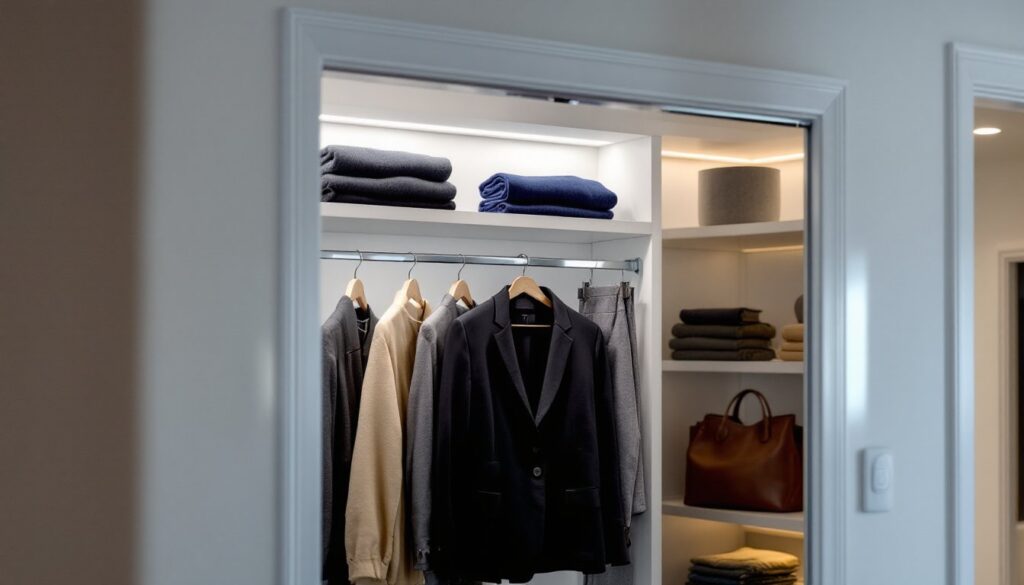
A dark closet isn’t just inconvenient, it’s where black shirts go to hide from navy ones, where you can’t tell if those pants are clean, and where you’re guaranteed to lose at least one earring per week. Good closet lighting transforms the space from a dim cave into a functional dressing area. The right setup makes mornings faster, keeps your wardrobe organized, and prevents that awkward moment when you realize you’ve worn mismatched socks to work. This guide covers the most practical closet lighting options available in 2026, from simple plug-and-stick solutions to permanent hardwired fixtures, with real-world advice on what works for different closet sizes and budgets.
Table of Contents
ToggleKey Takeaways
- Proper closet lighting options must prioritize color accuracy and eliminate shadows, with cool white (5000K-6500K) rendering colors most accurately for outfit coordination.
- LED strip lights offer the most versatile solution for reach-in closets, providing even illumination under shelves and along rods with minimal installation effort.
- Motion-activated closet lights eliminate the need for switches when carrying laundry or items, using either passive infrared or microwave sensors depending on your closet size.
- Brightness should measure 50-75 lumens per square foot, requiring multiple light sources in larger spaces rather than a single overhead fixture.
- Battery-powered puck lights provide the fastest DIY upgrade without wiring, though hardwired fixtures deliver the brightest and most reliable solution for walk-in closets.
- All hardwired closet lighting must maintain at least 6-12 inches of clearance from storage areas per electrical code to prevent fire hazards.
Why Proper Closet Lighting Matters
Closets rarely get natural light, and the standard overhead bulb in the hallway doesn’t reach into corners or illuminate hanging clothes properly. Proper lighting does three things: it lets you see true colors (critical for matching outfits), it eliminates shadows that hide items in the back, and it makes the space feel larger and more organized.
Color accuracy matters more than most people realize. The Kelvin rating of your bulb changes how colors appear, warm bulbs (2700K-3000K) make whites look yellowish, while cool bulbs (4000K-5000K) render colors more accurately. If you’re trying to match a black blazer with black pants, that difference is the line between coordinated and mismatched.
Task lighting beats ambient lighting in closets. You need focused light where you’re working, at eye level for shelves, angled down for hanging rods, and inside drawers if they’re deep. A single overhead fixture leaves the bottom two-thirds of the closet in shadow, which is why layered lighting from multiple sources works better for walk-ins and reach-ins alike.
LED Strip Lights for Versatile Closet Illumination
LED strip lights (also called tape lights) mount under shelves, along closet rods, or inside cabinets to deliver even, shadow-free lighting exactly where you need it. They’re available in plug-in or hardwired versions, typically draw 3-6 watts per foot, and last 25,000-50,000 hours.
Installation is straightforward for plug-in strips. Clean the surface with isopropyl alcohol, peel the adhesive backing, press firmly, and plug the transformer into an outlet. For hardwired versions, you’ll need to connect to a junction box or nearby circuit, this may require an electrician if you’re not comfortable working with 120V wiring. Always check your local electrical code: some jurisdictions require a permit for hardwired lighting in closets.
Look for strips rated at 300-450 lumens per foot for adequate brightness. Lower-density strips (60 LEDs per meter) work for accent lighting, but higher-density versions (120 LEDs per meter) eliminate the dotted look and provide more uniform illumination. Many homeowners installing similar pantry lighting solutions find that higher-density strips deliver better results in confined spaces.
Dimmable strips add flexibility. Pair them with a compatible dimmer switch or remote control to adjust brightness based on time of day, full brightness for getting dressed, dimmed for late-night access. Make sure the transformer supports dimming: not all LED drivers do.
One downside: adhesive backing fails on textured surfaces or in high-humidity environments. Use mounting clips or aluminum channels for more secure installation, especially on wire shelving or unfinished wood. Channels also diffuse the light and give a cleaner finished look.
Motion-Activated Closet Lights for Hands-Free Convenience
Motion-activated lights turn on when you open the door or step inside, then shut off automatically after 15-90 seconds of inactivity. They’re ideal for closets where you’re carrying laundry, holding hangers, or juggling shoes, situations where fumbling for a switch is inconvenient.
Two sensor types dominate the market: passive infrared (PIR) sensors detect body heat, while microwave sensors detect motion through walls and doors. PIR sensors are cheaper and work well in small reach-in closets. Microwave sensors are more sensitive and work in walk-ins, but they can trigger through thin walls if placement isn’t thoughtful.
Battery-powered motion lights mount with adhesive strips or screws and require no wiring. Expect to replace batteries (usually 3-4 AA) every 6-12 months depending on use. Some models now include rechargeable lithium-ion batteries with USB charging, more eco-friendly and cheaper long-term. Reviews on sites like Tom’s Guide frequently compare battery life and sensor accuracy across different models.
Hardwired motion lights connect to your home’s electrical system and often integrate with existing switches. These are code-compliant for new construction and renovations, and they eliminate battery changes. The NEC (National Electrical Code) allows motion sensors in closets as long as they’re ceiling- or wall-mounted at least 12 inches away from storage areas to prevent fire hazards from heat buildup.
Adjust the sensor range and timeout settings during installation. If the light turns off while you’re still digging through coat pockets, increase the timeout. If it triggers when someone walks past the closet door, reduce the sensitivity or reposition the sensor.
Battery-Powered Puck Lights and Wireless Solutions
Puck lights are small, round fixtures (typically 3-4 inches in diameter) that mount to shelves, ceilings, or walls with adhesive pads or screws. Battery-powered versions are the fastest DIY closet lighting upgrade, no wiring, no electrician, and you can reposition them if the first spot doesn’t work out.
Most puck lights use push-on/push-off switches, but remote-controlled versions are increasingly common. A single remote can control multiple lights, letting you turn on an entire closet from one switch mounted near the door. Expect 50-100 lumens per puck, so plan on 2-3 units for a standard reach-in closet or 4-6 for a walk-in.
Battery life varies wildly. Basic models with alkaline AAA batteries last 20-40 hours of cumulative use: rechargeable lithium models last longer per charge but need recharging every few months. If you’re frequently forgetting to turn them off, look for models with auto-shutoff timers. Organizational advice from Real Simple often highlights the importance of low-maintenance solutions in high-use storage areas.
Adhesive mounting works on smooth painted drywall, melamine, and metal shelving. It fails on rough or porous surfaces like unfinished wood or textured wallpaper. For those surfaces, use the screw-mount option, predrill pilot holes to prevent splitting, especially near shelf edges.
Wireless solutions now include smart puck lights compatible with Alexa, Google Assistant, or HomeKit. You can control them by voice, set schedules, or link them to motion sensors elsewhere in your home. These typically cost 2-3x more than standard puck lights, but they add convenience if you’re already invested in a smart home ecosystem.
Hardwired Overhead and Recessed Lighting Options
For walk-in closets or during renovations, hardwired lighting offers the brightest, most reliable solution. These fixtures connect directly to your home’s electrical system, require no battery changes, and integrate with wall switches or smart home controls.
Flush-mount or semi-flush fixtures install directly to a ceiling junction box. Look for LED fixtures with enclosed housings rated for closet use, the NEC prohibits open-bulb fixtures in closets because of fire risk from fabric and cardboard storage. A 1000-1500 lumen fixture works for most 6×8-foot closets.
Recessed can lights (also called downlights) sit flush with the ceiling and provide clean, unobtrusive illumination. Standard 4-inch or 6-inch cans work well: choose LED retrofit kits or dedicated LED cans for energy efficiency and lower heat output. Proper recessed lighting placement is critical, space fixtures 3-4 feet apart and avoid positioning them directly above hanging rods, which creates shadows on clothing.
Installation requires cutting ceiling holes (for recessed lights) or mounting a junction box (for surface fixtures). If you’re comfortable working with electrical wiring, verify power is off at the breaker, follow the manufacturer’s wiring diagram, and use wire nuts rated for the amperage. If not, hire a licensed electrician. Most jurisdictions require a permit and inspection for new circuits or fixtures added to existing circuits.
Track lighting is another hardwired option that lets you adjust light direction. It’s especially useful in walk-ins with irregular layouts or angled ceilings. Mount the track to the ceiling or upper wall, snap in adjustable heads, and aim them at shelves, rods, or shoe racks as needed.
All hardwired closet lighting must comply with NEC Article 410.16, which mandates clearances between fixtures and storage. Keep at least 12 inches of clearance for surface-mounted fixtures and 6 inches for recessed fixtures. This prevents heat buildup and reduces fire risk. Understanding the broader context of lighting styles helps ensure your closet lighting complements the rest of your home.
Choosing the Right Brightness and Color Temperature
Lumens measure brightness, not watts. A well-lit closet needs 50-75 lumens per square foot. For a 6×8-foot closet (48 sq ft), that’s 2400-3600 lumens total. Split that across multiple fixtures to eliminate shadows, three 800-lumen strips or four 600-lumen puck lights work better than one 3000-lumen overhead.
Color temperature (measured in Kelvin) drastically affects usability. Warm white (2700K-3000K) creates a cozy feel but distorts colors, navy looks black, and brown looks like dark gray. Neutral white (3500K-4000K) balances warmth and clarity. Cool white (5000K-6500K) renders colors most accurately and is ideal for closets where you’re coordinating outfits.
For walk-in closets used as dressing rooms, many designers recommend layering two color temperatures: neutral white (4000K) for task lighting at eye level and warm white (3000K) for ambient overhead lighting. This adds depth without sacrificing color accuracy where it matters most.
CRI (Color Rendering Index) measures how accurately a light source shows colors compared to natural sunlight. Look for LED fixtures with a CRI of 90 or higher, especially important if your wardrobe includes subtle color variations. Cheap LED strips often have CRIs in the 70-80 range, which makes similar colors look identical under artificial light. Many creative storage solutions recommend pairing quality lighting with modular closet systems for optimal functionality.
Dimming capability adds versatility. If you access your closet at night and don’t want full brightness, install dimmable LEDs with a compatible dimmer switch. Not all LEDs dim smoothly, some flicker at low settings or have a limited dimming range. Check compatibility between the bulb and dimmer before purchasing.
Conclusion
The best closet lighting depends on your space, budget, and how much effort you’re willing to invest. Battery-powered puck lights and plug-in LED strips handle most reach-in closets without tools or electrical work. Walk-ins and renovations justify hardwired fixtures that deliver brighter, more permanent solutions. Motion activation makes sense for high-traffic closets: manual switches work fine for occasional use. Start with proper brightness and color temperature, and the rest is just picking the mounting method that fits your situation.