
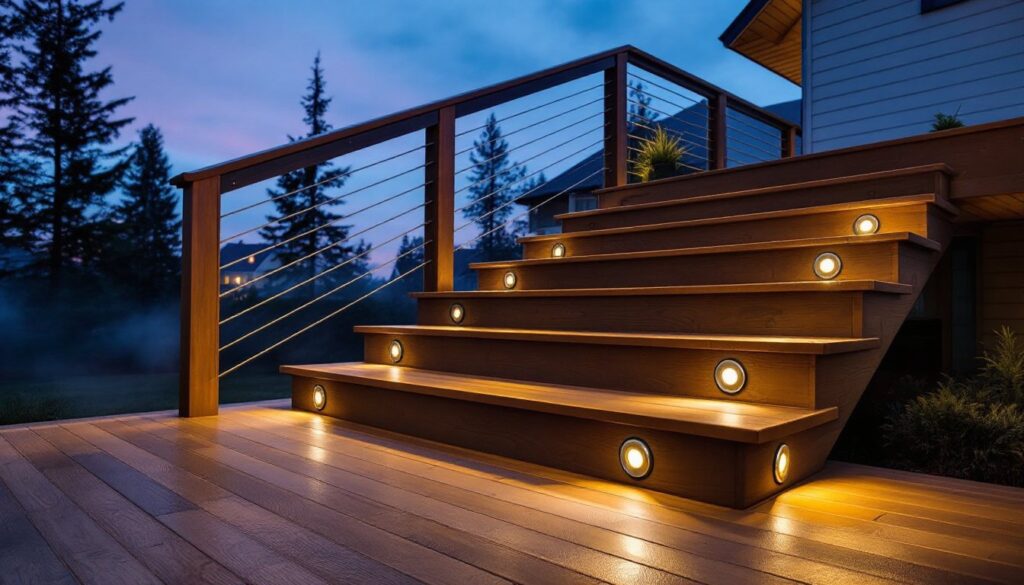
Stumbling down deck stairs in the dark isn’t just inconvenient, it’s a genuine safety hazard that sends thousands of homeowners to the ER each year. Properly lit deck stairs eliminate that risk while adding a polished look to any outdoor space. Whether someone’s hosting an evening gathering or just letting the dog out after sunset, good lighting makes all the difference. This guide walks through the options, decision factors, and installation steps for adding effective deck stair lighting that balances safety, aesthetics, and budget.
Table of Contents
ToggleKey Takeaways
- Deck lighting for stairs is essential for safety, as building codes recommend or require illumination for outdoor stairs with three or more risers to meet the International Residential Code (IRC) minimum of 1 foot-candle at tread level.
- Recessed step lights, post cap lights, and LED strip lighting are the primary deck stair lighting solutions, each offering different installation methods, aesthetics, and suitability depending on deck material and design preferences.
- Low-voltage (12V or 24V) systems are safer and easier to install than line-voltage options, requiring only a plug-in transformer and making them ideal for DIY deck lighting projects without needing an electrician.
- Proper brightness for deck stairs should range from 30 to 50 lumens per step with warm white (2700K to 3000K) color temperature to balance safety and create a welcoming ambiance.
- Common installation mistakes like undersized transformers, poor wire connections, and ignoring material expansion can be prevented by choosing the right transformer capacity, using quality connectors, and allowing for deck movement.
Why Deck Stair Lighting Matters for Safety and Curb Appeal
Deck stairs present a unique challenge after dark. Unlike a flat walking surface, each tread and riser creates a shadow that can hide depth perception cues. The result? Misjudged steps and potential falls.
Safety is the primary driver. Building codes in many jurisdictions now recommend or require illumination for outdoor stairs with three or more risers. While requirements vary by location, the International Residential Code (IRC) suggests lighting that provides at least 1 foot-candle of illumination at tread level. Even where it’s not mandated, adequate lighting reduces liability and gives homeowners peace of mind.
Beyond safety, lighting enhances curb appeal. Thoughtfully placed lights highlight architectural details, extend the usable hours of outdoor spaces, and create visual continuity from the deck to the yard. A well-lit stairway signals a maintained, welcoming property, important whether someone’s entertaining guests or considering resale value down the line.
Finally, deck stair lighting integrates with broader outdoor lighting strategies. Coordinating stair lights with pathway, railing, or landscape lighting creates a cohesive nighttime aesthetic that elevates the entire outdoor environment.
Types of Deck Stair Lighting Solutions
Recessed Step Lights
Recessed step lights mount flush into stair risers or directly into the underside of each tread. They provide downward-facing illumination that clearly defines each step edge without causing glare.
These fixtures typically measure 3 to 4 inches in diameter and require a cutout in the riser or tread material. Most use LED bulbs rated for outdoor use, drawing 1 to 3 watts per fixture. Voltage options include line-voltage (120V) and low-voltage (12V) systems: low-voltage is safer and easier for DIYers to install.
Recessed lights work best on wood or composite decks where cutting into the material won’t compromise structural integrity. They’re a poor fit for thin metal or open-riser stairs. Installation involves drilling pilot holes, routing wire through the structure, and securing each fixture with mounting clips or screws. This approach delivers a clean, modern look and is one of the most popular choices for new deck builds, as noted in many DIY installation guides.
Post Cap and Railing Lights
Post cap lights sit atop newel posts or deck railing posts, casting ambient light downward and outward. They’re simple to install, most mount with screws or adhesive, and require no cutting into deck surfaces.
These lights come in solar, battery-powered, and low-voltage wired versions. Solar post caps are the easiest to add (no wiring at all), but their brightness depends on daily sun exposure and battery capacity. Wired versions provide consistent output and are better suited to climates with limited sun or for homeowners who want reliable, year-round performance.
Railing lights attach to the horizontal or vertical railing members and illuminate the stair area from the sides. They’re versatile and can be spaced to match the homeowner’s aesthetic preferences. For stairs flanked by railings, a combination of railing-mounted fixtures and post caps often provides the most even coverage.
Both options are retrofit-friendly, making them ideal for existing decks. But, they don’t always provide as precise tread-edge illumination as recessed fixtures, so they work best when paired with another lighting type or when ambient light sufficiency is acceptable.
Strip and Rope Lighting
LED strip lighting consists of flexible, adhesive-backed strips that mount under the nose of each tread or along the underside of stair stringers. These strips come in various lengths (commonly sold by the foot or in reels) and can be cut to size at designated intervals.
Strip lights provide continuous linear illumination, which creates a modern, architectural effect. They’re available in different color temperatures (2700K warm white to 5000K daylight) and some RGB options for decorative purposes. Most outdoor-rated strips carry an IP65 or IP67 rating, meaning they’re protected against dust and water jets.
Rope lighting is similar but uses a thicker, round PVC or silicone housing. It’s more durable than basic strip lights but less flexible. Both types connect to a low-voltage transformer (typically 12V or 24V) and can be dimmed with compatible controllers.
Installation is straightforward: clean the mounting surface, peel the backing, press the strip into place, and connect to the power supply. The main challenge is ensuring the adhesive bonds well to composite or treated lumber, sometimes an additional dab of exterior-grade construction adhesive or mounting clips is necessary. This method is highlighted in many home improvement tutorials for its ease and visual impact.
For best results, route wiring through conduit or along hidden pathways to prevent tripping hazards and UV damage to cables.
How to Choose the Right Lighting for Your Deck Stairs
Choosing the right lighting involves balancing several factors: deck material, power source, brightness, and aesthetic goals.
Deck material dictates installation ease. Wood and composite decks accept recessed fixtures and strip lights readily. Metal or vinyl railings may limit mounting options to clamp-on or adhesive fixtures. Always check manufacturer specs to confirm compatibility.
Power source is a major decision point. Low-voltage systems (12V or 24V) are safer, easier to install, and meet code in most areas without requiring an electrician. They use a plug-in transformer that steps down household 120V power. Line-voltage (120V) systems deliver brighter output and handle longer wire runs but typically require a licensed electrician and GFCI-protected circuits per the National Electrical Code (NEC). Solar and battery-powered options eliminate wiring but may lack the brightness or consistency needed for primary stair lighting, they work well as supplements.
Brightness and color temperature matter for both safety and ambiance. For stairs, aim for fixtures that provide 30 to 50 lumens per step. Too dim, and the lighting won’t improve safety: too bright, and glare becomes an issue. Warm white (2700K to 3000K) is the most popular choice, offering a welcoming glow that complements most outdoor settings. Cooler temperatures (4000K+) can feel clinical but work well in modern, minimalist designs.
Aesthetic integration is the final piece. Lights should complement the deck’s overall design. Recessed fixtures suit contemporary builds, while post cap lights fit traditional or craftsman styles. For exterior accent lighting, consider how stair lights will coordinate with landscape spotlights or wall-mounted sconces on adjacent structures.
Budget ranges widely. Solar post caps start around $15 each: low-voltage recessed kits (6 to 8 lights plus transformer) run $100 to $250: line-voltage systems with professional installation can exceed $500. Factor in wire, connectors, and any tools needed (hole saws, wire strippers, conduit).
Finally, if the deck is new construction, plan lighting during the build phase. Retrofitting is doable but often requires fishing wire through finished surfaces or surface-mounting conduit, manageable, but more labor-intensive.
Installing Deck Stair Lighting: A Step-by-Step DIY Guide
This guide covers a typical low-voltage recessed step light installation on a wood or composite deck. Adjust as needed for other fixture types.
Tools and Materials:
- Low-voltage LED step lights (one per riser or tread)
- Low-voltage transformer (sized to total wattage: add 20% buffer)
- 12V or 14V outdoor-rated low-voltage cable
- Wire connectors (twist-on or heat-shrink)
- Hole saw (sized to fixture diameter, usually 3″ or 3.5″)
- Drill/driver
- Wire strippers
- Measuring tape and pencil
- Safety glasses and work gloves
Step-by-Step Process:
-
Plan the layout. Decide whether to mount lights on risers (vertical face) or under tread noses. Riser mounting is more common and provides better downward illumination. Mark the center point of each riser, typically 4 to 6 inches from one edge to avoid cutting into structural fasteners.
-
Check for obstructions. Before drilling, verify that screws, joist hangers, or blocking won’t interfere. Probe with a stud finder or inspection camera if unsure.
-
Cut the fixture holes. Using the hole saw, drill through the riser at each marked location. Go slowly to prevent tear-out on the back side. For composite decking, a sharp bi-metal hole saw works best: for pressure-treated lumber, a standard wood hole saw is fine.
-
Run the low-voltage cable. Start at the transformer location (typically near an outdoor outlet on the house or deck post). Route cable along the underside of the deck or through drilled holes in the stringers. Leave 12 to 18 inches of extra wire at each fixture location for connections. Secure cable with staples or clips every 2 to 3 feet, keeping it away from high-traffic areas.
-
Connect the fixtures. Most low-voltage step lights use quick-connect terminals or screw terminals. Strip 1/4 inch of insulation from the cable, insert into the fixture’s terminal, and tighten. If using twist-on connectors, match wire gauge (usually 14 or 16 AWG) and twist clockwise until snug, then secure with electrical tape or heat-shrink tubing.
-
Mount the fixtures. Insert each light into its hole and secure with the provided clips, screws, or friction fit. Ensure the lens or trim ring sits flush against the riser.
-
Connect to the transformer. At the transformer end, strip the main cable and attach to the transformer’s output terminals (observe polarity if specified, though most low-voltage systems are polarity-agnostic). Plug the transformer into a GFCI-protected outlet. Many transformers include a photocell or timer, set it to turn lights on at dusk and off at a specified time or dawn.
-
Test the system. Power on the transformer and verify each fixture illuminates. If any are dim or off, check connections for continuity and ensure total wattage doesn’t exceed the transformer’s rating.
-
Secure and weatherproof. Tuck excess wire neatly under the deck or into junction boxes. Apply a bead of silicone caulk around fixture edges if needed to prevent moisture intrusion (follow manufacturer guidance).
Safety Notes:
- Wear safety glasses when drilling to protect against flying debris.
- If working on an elevated deck, ensure stable footing or use a helper.
- Low-voltage systems are generally safe to install without a permit, but line-voltage work typically requires a licensed electrician and inspection. Check local building codes.
- Use only outdoor-rated fixtures and cable. Indoor products will corrode and fail.
Alternative Methods:
For strip lighting, skip the hole saw and instead mount strips with adhesive and/or mounting clips along tread undersides. Power routing is similar, run cable to a central transformer and connect strips in series or parallel per manufacturer instructions.
For solar post caps, installation is even simpler: screw or glue the cap onto the post top, ensure the solar panel faces south (in the Northern Hemisphere), and let it charge. No wiring required, though performance depends on sunlight exposure.
Common Pitfalls to Avoid:
- Undersized transformer: Total all fixture wattages and choose a transformer rated at least 20% higher. Overloading causes dimming and early failure.
- Poor wire connections: Loose or corroded connections are the #1 cause of low-voltage lighting issues. Use quality connectors and protect them from moisture.
- Skipping the photocell or timer: Manually switching lights on and off gets old fast. Automation ensures consistent operation.
- Ignoring material expansion: Composite decking expands and contracts with temperature. Don’t over-tighten fixture screws: allow slight movement.
For more complex installations, such as integrating stair lights with modern wall lighting or whole-deck systems, consider consulting a professional guide or hiring a licensed low-voltage lighting installer. They can design a cohesive system, handle transformer sizing, and ensure code compliance.