
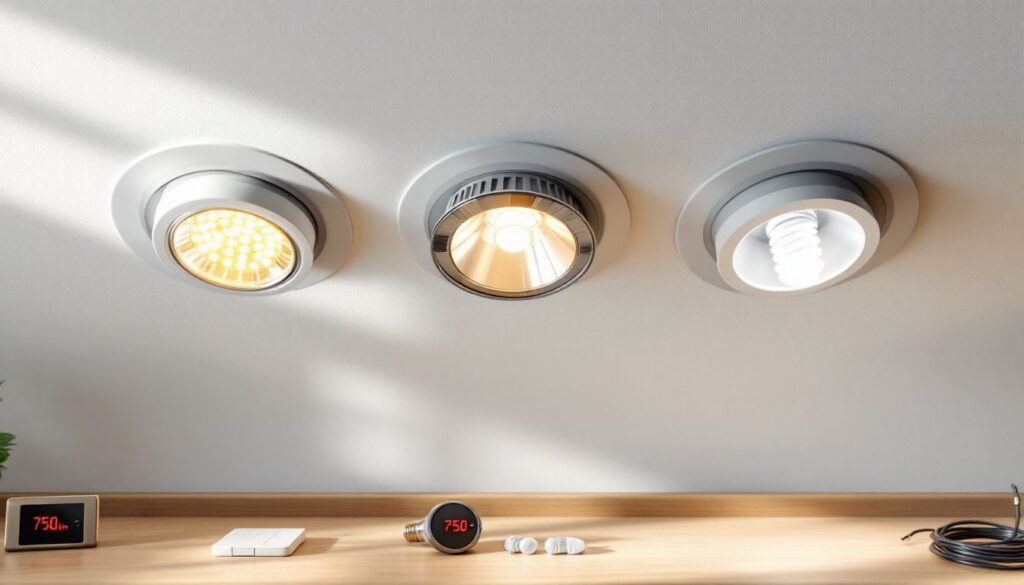
Recessed lighting, sometimes called can lights or downlights, delivers a clean, modern look without hanging fixtures to dust or bump your head on. But the bulb you choose can make or break the whole setup. Pick the wrong size, color temperature, or wattage, and you’ll end up with harsh shadows, flickering dimmers, or a ceiling full of bulbs that burn out faster than you can replace them. This guide walks through everything needed to choose the right light bulbs for recessed fixtures, from bulb types and sizes to brightness, efficiency, and installation pitfalls.
Table of Contents
ToggleKey Takeaways
- LED bulbs for recessed lighting are the gold standard, lasting 15,000 to 50,000 hours while using a fraction of the power and paying back their higher upfront cost within one to two years.
- Match light bulbs for recessed lighting to your fixture size—BR30 for 4-inch cans, BR40 for 6-inch cans—and choose between BR (soft, wide beam) or PAR (focused beam) based on whether you need ambient or accent lighting.
- Select brightness in lumens (400–600 for ambient living spaces, 700–900 for kitchens) and stick to one color temperature range throughout a room to avoid a mismatched, amateurish appearance.
- Always use an LED-compatible dimmer switch to avoid flickering or buzzing, and test dimming performance with a single bulb before buying in bulk.
- Prioritize ENERGY STAR-certified LED bulbs and respect your fixture’s maximum wattage and IC (insulation contact) ratings to ensure safety, code compliance, and optimal performance.
Understanding Recessed Lighting Bulb Types
Not all recessed bulbs are created equal. The three main types, LED, halogen, and CFL, each have distinct characteristics that affect brightness, lifespan, heat output, and compatibility with existing fixtures.
LED vs. Halogen vs. CFL Bulbs
LED (light-emitting diode) bulbs are the current gold standard for recessed lighting. They draw a fraction of the power of older bulb types, produce minimal heat, and last 15,000 to 50,000 hours depending on quality. Most LEDs are dimmable if paired with a compatible dimmer switch (more on that later), and they’re available in a full spectrum of color temperatures from warm white (2700K) to daylight (5000K+). The main trade-off is upfront cost, quality LEDs run $8 to $20 per bulb, but the long lifespan and energy savings usually pay back within a year or two.
Halogen bulbs are essentially souped-up incandescents. They produce crisp, bright light with excellent color rendering (CRI of 100), making them popular for task lighting in kitchens or galleries. But they run hot, hot enough to scorch insulation if installed in IC-rated (insulation contact) housings without proper clearance, and they burn out in 2,000 to 4,000 hours. They’re also energy hogs, drawing 40 to 90 watts to match the output of a 10- to 15-watt LED. Halogen bulbs are still found in older fixtures and are a good short-term replacement if you’re not ready to retrofit, but they’re being phased out in many regions due to efficiency standards.
CFL (compact fluorescent) bulbs were the efficiency darling before LEDs took over. They use about 75% less energy than incandescents and last 8,000 to 15,000 hours. The downsides: they contain a small amount of mercury (requiring careful disposal), take a few seconds to reach full brightness, and often flicker or hum when dimmed. Most DIYers skip CFLs now in favor of LEDs, but if you’ve got a stash in the garage, they’ll work fine in non-dimmed applications.
How to Choose the Right Bulb Size and Shape
Recessed fixtures come in standardized sizes, and the bulb has to fit both the housing diameter and the trim style. Mismatch these, and you’ll be making a return trip to the hardware store.
Most residential recessed cans are either 4-inch, 5-inch, or 6-inch diameter. The bulb size corresponds to the housing: a 4-inch can takes a BR30 or PAR20 bulb, a 5-inch can typically uses a BR30, and a 6-inch can takes a BR40 or PAR38. The “BR” stands for bulged reflector (a wide, soft beam), while “PAR” stands for parabolic aluminized reflector (a more focused, controlled beam). For general room lighting, BR bulbs work well. For accent lighting, highlighting art or architectural features, PAR bulbs give you better beam control.
The number after BR or PAR indicates the diameter in eighths of an inch. A BR30 bulb measures 30/8 inches, or 3.75 inches across. A BR40 is 5 inches. Always measure your existing trim or check the fixture’s documentation before buying bulbs in bulk.
If you’re retrofitting old fixtures, consider integrated LED retrofit kits. These replace the entire trim and bulb assembly with a single low-profile LED unit that clips or screws into the existing housing. They’re often easier to install than swapping bulbs, especially if your old cans use oddball sockets or proprietary trims. Many recessed lighting installations now favor retrofit kits for their streamlined appearance and foolproof fit.
Brightness, Color Temperature, and Dimming Compatibility
Brightness in LEDs is measured in lumens, not watts. A 60-watt incandescent puts out about 800 lumens: a comparable LED draws only 8 to 10 watts. For general ambient lighting in a living room or bedroom, aim for 400 to 600 lumens per bulb in a 6-inch can. Kitchens and task areas benefit from 700 to 900 lumens per bulb. Too much light creates glare and harsh shadows: too little leaves the room feeling dim and unwelcoming.
Color temperature is measured in Kelvins (K) and dramatically affects the mood of a space. Warm white (2700K to 3000K) mimics the glow of incandescent bulbs, cozy and inviting, ideal for living rooms, bedrooms, and dining areas. Neutral white (3500K to 4100K) is crisper and works well in kitchens, bathrooms, and home offices. Daylight (5000K+) feels clinical and is best reserved for workshops, garages, or task lighting where color accuracy matters. Mixing color temperatures in the same room usually looks like a mistake, so stick with one range throughout a space.
Dimming is where things get tricky. Not all LEDs are dimmable, and even those labeled “dimmable” won’t work with every dimmer switch. Older rotary or slide dimmers designed for incandescents can cause LEDs to flicker, buzz, or cut out at low levels. For reliable dimming performance, use a dimmer rated for LED or CFL loads (check the packaging for compatibility). Lutron, Leviton, and Legrand all make solid LED-compatible dimmers in the $15 to $40 range. If you’re installing multiple recessed lights on one circuit, make sure the dimmer’s wattage rating exceeds the total load. For example, ten 10-watt LEDs draw 100 watts, so use a dimmer rated for at least 150 watts.
Another gotcha: not all dimmable LEDs dim to the same level. Some bottom out at 20% brightness, others go down to 5%. If you want true mood lighting, test a single bulb with your dimmer before buying a case. Some manufacturers publish minimum load requirements, if your dimmer doesn’t see enough wattage, it won’t dim smoothly. In those cases, adding one incandescent bulb to the circuit (a “dummy load”) can stabilize performance, though it’s an inelegant fix.
Energy Efficiency and Cost Considerations
LEDs cost more upfront but save significantly over their lifespan. A quality LED bulb runs $10 to $15 for a BR30, while a comparable halogen is $4 to $6. But that halogen will burn 50 watts and last 2,000 hours. The LED draws 10 watts and lasts 25,000 hours. Over 25,000 hours of use at $0.13 per kWh (the national average), the halogen costs about $163 in electricity: the LED costs $33. Add in 12 halogen replacements at $5 each ($60), and the total cost of ownership is $223 for halogen versus $43 for LED. That’s $180 in savings per bulb over the long haul.
For a whole-house recessed lighting retrofit, say, 20 bulbs, the math gets even more compelling. Swapping halogen for LED saves roughly $3,600 in energy and replacement costs over the bulbs’ lifespan. Even if you’re renting or don’t plan to stay in the home long-term, the payback period is usually under two years.
Many high-efficiency LED bulbs are ENERGY STAR certified, meaning they’ve met strict efficiency and performance standards. Look for the label, it’s a quick way to filter out low-quality imports that exaggerate lumen output or fail early. ENERGY STAR bulbs also tend to have better color rendering (CRI of 80 to 90+), which makes skin tones, fabrics, and finishes look more natural.
If you’re budgeting for a new build or major remodel, price per bulb matters less than total system cost. In that case, consider integrated LED fixtures instead of separate housings and bulbs. While they’re not field-serviceable (when the LED dies, you replace the entire unit), integrated fixtures often last 50,000 hours or more, 20+ years at typical residential use. Some jurisdictions now require them in new construction to meet energy codes.
Installation Tips and Common Mistakes to Avoid
Swapping recessed bulbs is straightforward, but a few gotchas can trip up even experienced DIYers.
First, always turn off power at the breaker, not just the wall switch. Recessed housings are energized even when the switch is off if you’re dealing with three-way switching or smart controls. Use a non-contact voltage tester to confirm the circuit is dead before touching anything.
Second, let bulbs cool before removal. Halogens and older incandescents get hot enough to blister skin. Even LEDs can be warm to the touch after extended use.
Third, check the fixture’s insulation contact (IC) rating. IC-rated housings are designed to be buried in insulation without overheating: non-IC housings require 3 inches of clearance on all sides. If you install a high-wattage halogen in a non-IC housing surrounded by blown-in insulation, you’re risking a fire. LEDs run cooler and are more forgiving, but it’s still worth confirming the rating, especially in older homes. Proper fixture spacing and placement also affects heat buildup and light distribution.
Fourth, match the bulb’s base type to the socket. Most recessed cans use medium screw bases (E26), but some decorative or European fixtures use GU10 twist-lock bases or E12 candelabra bases. Double-check before you buy.
Fifth, respect the fixture’s maximum wattage rating. It’s usually printed on a label inside the housing. Exceeding it, even with an LED that runs cooler, can void the fixture’s UL listing and create a code compliance issue if you ever sell the house. Most modern housings are rated for 65 to 75 watts, which is plenty for any LED but can be limiting if you’re still running halogens.
Finally, don’t overtighten screw-in bulbs. LEDs have plastic bases that can crack under too much torque. Hand-tight is enough. If a bulb is loose or flickering, the problem is usually a worn socket or poor contact, replace the socket or the entire housing rather than cranking down harder on the bulb.
For new installations or retrofits involving multiple fixtures and circuits, consider consulting a licensed electrician, especially if you’re punching new holes in a ceiling with limited attic access or working near HVAC ducts and structural members. Most jurisdictions require permits for adding new circuits or modifying existing ones, and inspections ensure the work meets current NEC (National Electrical Code) standards.
One last note: if you’re replacing bulbs in a bathroom or shower area, make sure they’re rated for damp or wet locations. Standard bulbs and housings aren’t sealed against moisture and can fail prematurely or create a shock hazard. Look for fixtures with a gasket or rubber seal and bulbs explicitly labeled for wet use.
Conclusion
Choosing the right bulbs for recessed lighting comes down to matching size, brightness, and color temperature to the room’s needs, then prioritizing efficiency and dimming performance. LEDs are the clear winner for most applications, cooler, longer-lasting, and far cheaper to run than halogen or CFL alternatives. Take the time to verify fixture ratings, test dimmers with a single bulb, and respect basic safety protocols. Get it right, and recessed lighting delivers decades of clean, even illumination with minimal fuss.