
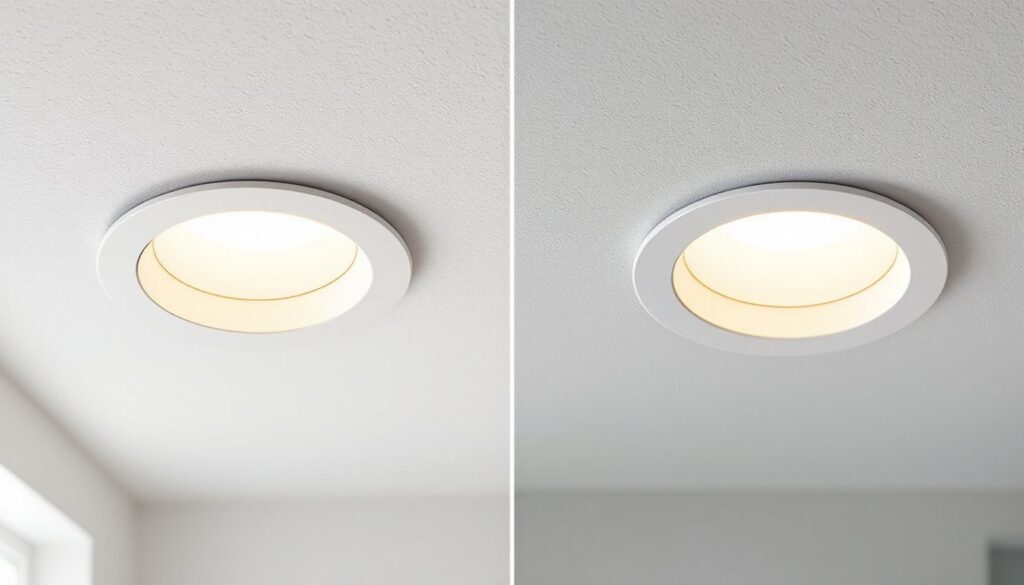
Choosing between 4 inch and 6 inch recessed lighting isn’t just about aesthetics, it affects illumination quality, energy consumption, installation complexity, and even your ceiling’s structural requirements. Most homeowners default to one size without understanding how fixture diameter impacts beam spread, lumen output, and visual balance in a room. The wrong choice can leave spaces feeling either over-lit with glaring hotspots or dim with shadowy corners. This guide breaks down the practical differences between these two popular can light sizes, helping DIYers and renovators match fixture dimensions to room function, ceiling height, and spacing requirements.
Table of Contents
ToggleKey Takeaways
- 4 inch vs 6 inch recessed lighting differs primarily in lumen output (600–900 for 4 inch, 800–1,400+ for 6 inch), beam spread, and ceiling clearance requirements, making fixture size critical to room brightness and installation feasibility.
- Choose 4 inch recessed lighting for hallways, closets, accent work, and shallow ceiling cavities where budget and space constraints are priorities, as they cost $10–$30 less per fixture and fit tighter joist bays.
- Select 6 inch fixtures for large living rooms, kitchens, and tall ceilings (10+ feet) where broad illumination and higher lumen capacity create uniform coverage without excessive fixture density.
- IC-rated recessed lighting housings are crucial for energy-efficient homes, allowing contact with insulation without overheating and preventing thermal weak spots that non-IC fixtures create.
- LED recessed lighting delivers 25,000–50,000 hour lifespans while consuming 8–18 watts (versus 65–150 watts for halogen), enabling 2–4 year payback through annual savings of $150–$250 on electricity.
- Proper fixture spacing is essential: space 4 inch lights 4–5 feet apart for ambient layouts and 6 inch fixtures 5–7 feet apart to avoid dark zones and optimize even illumination across rooms.
Understanding Recessed Lighting Sizes
Recessed lighting sizes refer to the diameter of the trim ring, the visible portion of the fixture after installation. A 4 inch fixture has a trim opening of approximately 4 inches, while a 6 inch unit measures roughly 6 inches across. But, the actual housing (the metal can that sits inside the ceiling) is larger: 4 inch fixtures typically require a 4.5 to 5 inch diameter housing, and 6 inch lights need a 7 to 7.5 inch housing.
The housing also requires vertical clearance in the ceiling cavity. Most 4 inch cans need 4 to 6 inches of clearance between the ceiling surface and any obstruction (joists, ductwork, insulation). Six inch fixtures demand 6 to 8 inches of clearance. New construction (NC) housings install before drywall goes up, while remodel (old work) housings use clips to anchor into existing ceilings through a cutout.
Both sizes come in IC-rated (insulation contact) and non-IC versions. IC-rated housings can touch insulation without overheating, crucial for energy-efficient homes with full attic insulation. Non-IC fixtures require a 3 inch clearance around the housing, which creates thermal weak spots. Always check local building codes, some jurisdictions now mandate IC-rated fixtures in all ceiling applications.
Modern LED retrofit kits let homeowners convert existing housings to LED without replacing the can. These kits typically specify compatibility with either 4 inch, 6 inch, or both housing sizes. The trim diameter determines the kit size needed, not the housing diameter.
Key Differences Between 4 Inch and 6 Inch Recessed Lights
The two sizes differ in light output, installation demands, and visual impact. Here’s how they stack up in real-world applications.
Light Output and Brightness Comparison
Lumen capacity scales with fixture size. Most 4 inch LED recessed lights deliver 600 to 900 lumens, suitable for ambient lighting in small to mid-sized rooms. Six inch fixtures push 800 to 1,400 lumens or more, providing stronger illumination for larger spaces or task-oriented areas.
Beam angle matters as much as raw lumens. Four inch fixtures typically produce a narrow beam spread (40 to 60 degrees), creating focused pools of light. This works well for accent lighting, highlighting artwork, or supplementing other light sources. Six inch cans offer wider beam angles (60 to 90 degrees), distributing light more evenly across floors and walls. In a 12×15 foot living room, 4 inch lights spaced 4 to 5 feet apart create distinct light circles with shadowy gaps between them. Six inch fixtures at the same spacing deliver more uniform coverage with fewer dark zones.
Color temperature and dimming compatibility remain consistent across sizes, both are available in warm white (2700K to 3000K), neutral white (3500K to 4100K), and daylight (5000K+) options. But, 6 inch fixtures handle dimming more smoothly at lower settings because their larger LED arrays dissipate heat better, reducing flicker and color shift when dimmed below 20%.
Installation Requirements and Ceiling Clearance
Four inch fixtures shine in tight spaces. They work in ceilings with 2×6 joists (5.5 inches actual depth) and shallow cavities where ductwork or wiring limits clearance. Cutting a 4.5 inch hole between joists leaves more margin for error and reduces the chance of hitting framing. For proper spacing between fixtures, 4 inch lights typically go 4 to 5 feet apart in ambient layouts.
Six inch housings require more planning. They need 2×8 or deeper joists (7.25 inches actual) or engineered trusses with adequate clearance. The larger cutout (7 to 7.5 inches) demands precise joist location, hit a joist with your hole saw, and you’ll need to patch drywall and shift the fixture location. In remodel scenarios, this size increases the risk of encountering obstacles. Spacing recommendations call for 5 to 7 feet between 6 inch fixtures, which means fewer fixtures overall but more cutting and wiring per light.
Both sizes require the same basic tools: hole saw (sized to housing specs), drywall saw, fish tape or flexible drill bit for wiring, and a non-contact voltage tester. Wiring follows standard practices, most fixtures accept 14-2 or 12-2 NM cable, with black (hot), white (neutral), and ground connections inside the housing’s junction box. Always shut off power at the breaker before cutting or wiring. Wear safety glasses when drilling overhead, and use a dust mask if cutting through old insulation or drywall.
Electrical codes matter here. The National Electrical Code (NEC) requires recessed fixtures to have integral junction boxes and thermal protection to prevent overheating. Some jurisdictions mandate AFCI (arc-fault circuit interrupter) protection on bedroom and living area circuits, which affects the breaker feeding your lights, not the fixtures themselves. If your project involves adding new circuits or rerouting wiring through walls, check if your local authority having jurisdiction (AHJ) requires a permit, most do for new circuits, fewer for simple fixture swaps on existing circuits.
When to Choose 4 Inch Recessed Lighting
Four inch fixtures excel in specific applications where space, budget, or lighting goals favor smaller housings.
Hallways and corridors benefit from 4 inch lights. A standard 3 to 4 foot wide hallway only needs fixtures spaced every 4 to 6 feet to maintain even illumination. Larger 6 inch cans look visually oversized and deliver more lumens than needed, wasting energy. Install them 4 feet apart down the centerline for balanced lighting.
Closets and small bathrooms often have joists running perpendicular to doorways, creating narrow joist bays. Four inch housings fit between 16 inch on-center joists with 14.5 inches of clear space, leaving room for installation. They also suit low ceilings (7 to 8 feet), where 6 inch fixtures can feel overpowering or create glare at eye level.
Accent and task lighting applications favor the focused beam of 4 inch lights. Use them over kitchen counters (18 inches from wall, 24 to 30 inches apart) to highlight work surfaces without flooding the entire room. They’re ideal for illuminating artwork, bookshelves, or architectural features where you want a spotlight effect rather than broad ambient light.
Shallow ceiling cavities make 4 inch fixtures the practical choice. Many older homes have 2×6 ceiling joists with limited clearance. Trying to jam a 6 inch housing into a 5.5 inch cavity requires rerouting ductwork or notching joists, both bad ideas. Notching ceiling joists weakens structural support and often violates the International Residential Code (IRC), which limits notch depth to one-sixth of joist depth at the outer third of the span.
Budget-conscious projects see savings with 4 inch fixtures. They cost $10 to $30 less per fixture than comparable 6 inch models, and installation goes faster (less cutting, easier wiring). For rooms requiring eight to twelve fixtures, the cost difference adds up. The lower lumen output also means less energy consumption, a typical 4 inch LED draws 8 to 12 watts, compared to 12 to 18 watts for 6 inch units.
When to Choose 6 Inch Recessed Lighting
Six inch fixtures dominate in high-demand lighting scenarios where brightness, coverage, and visual scale matter.
Living rooms, great rooms, and open floor plans need the broad illumination of 6 inch cans. A 15×20 foot living room with 9 foot ceilings typically requires six to eight 6 inch fixtures (spaced 5 to 6 feet apart) for comfortable ambient lighting. Swapping to 4 inch lights would demand ten to twelve fixtures to achieve similar brightness, cluttering the ceiling and increasing installation labor.
Kitchen general lighting relies on 6 inch fixtures for even, shadow-free illumination. Over islands or peninsulas, space them 3 to 4 feet apart to eliminate dark zones between fixtures. Their wider beam spread reduces the number of fixtures needed, simplifying wiring and switch control. Pairing 6 inch ambient lights with 4 inch task lights over counters creates layered lighting that handles both general visibility and focused work.
Tall ceilings (10 feet or higher) demand 6 inch lights. Light intensity follows the inverse square law, double the distance, and brightness drops to one-quarter. In a room with 12 foot ceilings, 4 inch fixtures deliver weak, scattered light at floor level. Six inch cans with higher lumen output maintain adequate brightness even though the distance. Consider advanced techniques for ceiling height calculations when planning fixture counts.
Commercial-grade illumination in home offices, workshops, or garages benefits from 6 inch fixtures. These spaces often require 50 to 75 foot-candles of light for detail work, reading plans, inspecting finishes, or assembling projects. Six inch lights spaced 4 to 5 feet apart deliver the consistent brightness professionals expect. Some contractors prefer them in basements for this reason, even though 4 inch lights fit the ceiling height, the extra lumens compensate for dark walls and furnishings.
Renovations targeting resale value lean toward 6 inch fixtures. They’re perceived as modern and high-end, while 4 inch lights sometimes read as builder-grade or dated. Buyers expect to see 6 inch recessed lighting in updated kitchens and primary bathrooms. That perception doesn’t always match reality (4 inch LEDs perform excellently in appropriate applications), but real estate psychology influences fixture selection.
Large housings also simplify future-proofing. If technology changes or you want to upgrade bulbs, 6 inch housings accept a wider range of retrofit kits and trim styles. Some smart LED retrofits (with integrated speakers or color-changing features) only come in 6 inch sizes due to component space requirements. For resources on advanced building methods, check construction best practices for updated techniques.
Cost Considerations and Energy Efficiency
Upfront costs for recessed lighting break into fixtures, installation labor (if hiring out), and electrical materials. Four inch IC-rated LED housings run $15 to $40 each, while 6 inch equivalents cost $25 to $60. Retrofit LED kits (trim and LED module) range from $8 to $25 for 4 inch and $12 to $35 for 6 inch. Prices vary by brand, lumen output, and features (dimmable, color-selectable, wet-rated for showers).
Material costs add up. For a typical kitchen project with eight fixtures, budget $200 to $400 for 4 inch fixtures or $300 to $500 for 6 inch. Include wire (14-2 NM cable at $0.40 to $0.60 per foot), wire nuts, junction boxes if splitting circuits, and a compatible dimmer switch ($20 to $80 for LED-rated dimmers). Don’t cheap out on dimmers, standard incandescent dimmers cause LED flicker and premature failure.
Professional installation costs $100 to $200 per fixture in most markets, covering labor for cutting, wiring, and patching. That pricing assumes accessible attic space and straightforward wiring. Vaulted ceilings, multi-story homes, or complex retrofit scenarios (fishing wire through finished walls) push costs toward the higher end. DIY installation saves that labor expense but demands comfort with electrical work and overhead cutting. For extensive projects, recessed lighting installation basics offer additional planning guidance.
Energy efficiency favors LEDs in both sizes. A 4 inch LED recessed light uses 8 to 12 watts and lasts 25,000 to 50,000 hours. Six inch LEDs draw 12 to 18 watts with similar lifespans. Compare that to old-school incandescent or halogen cans (65 to 150 watts, 2,000 to 4,000 hours), and the savings are dramatic. In a room with eight fixtures running four hours daily, switching from halogen to LED saves roughly $150 to $250 annually at typical electricity rates.
Payback period on LED upgrades runs two to four years depending on local energy costs and usage patterns. IC-rated fixtures also reduce thermal bridging in insulated ceilings, cutting heating and cooling costs by preventing air leaks around non-IC housings. The cumulative effect, lower wattage, longer life, better insulation performance, makes LED recessed lighting one of the most cost-effective upgrades in home improvement.
Size selection impacts efficiency indirectly. Using six 6 inch fixtures instead of ten 4 inch lights to achieve the same room brightness cuts total wattage by 20 to 30 percent because fewer fixtures waste less energy. But, oversizing fixtures (installing 1,200-lumen 6 inch lights in a small hallway) negates efficiency gains, you’ll dim them constantly or tolerate glare, and dimmed LEDs still consume more power than appropriately sized alternatives running at full output.